

20
Oct
2026
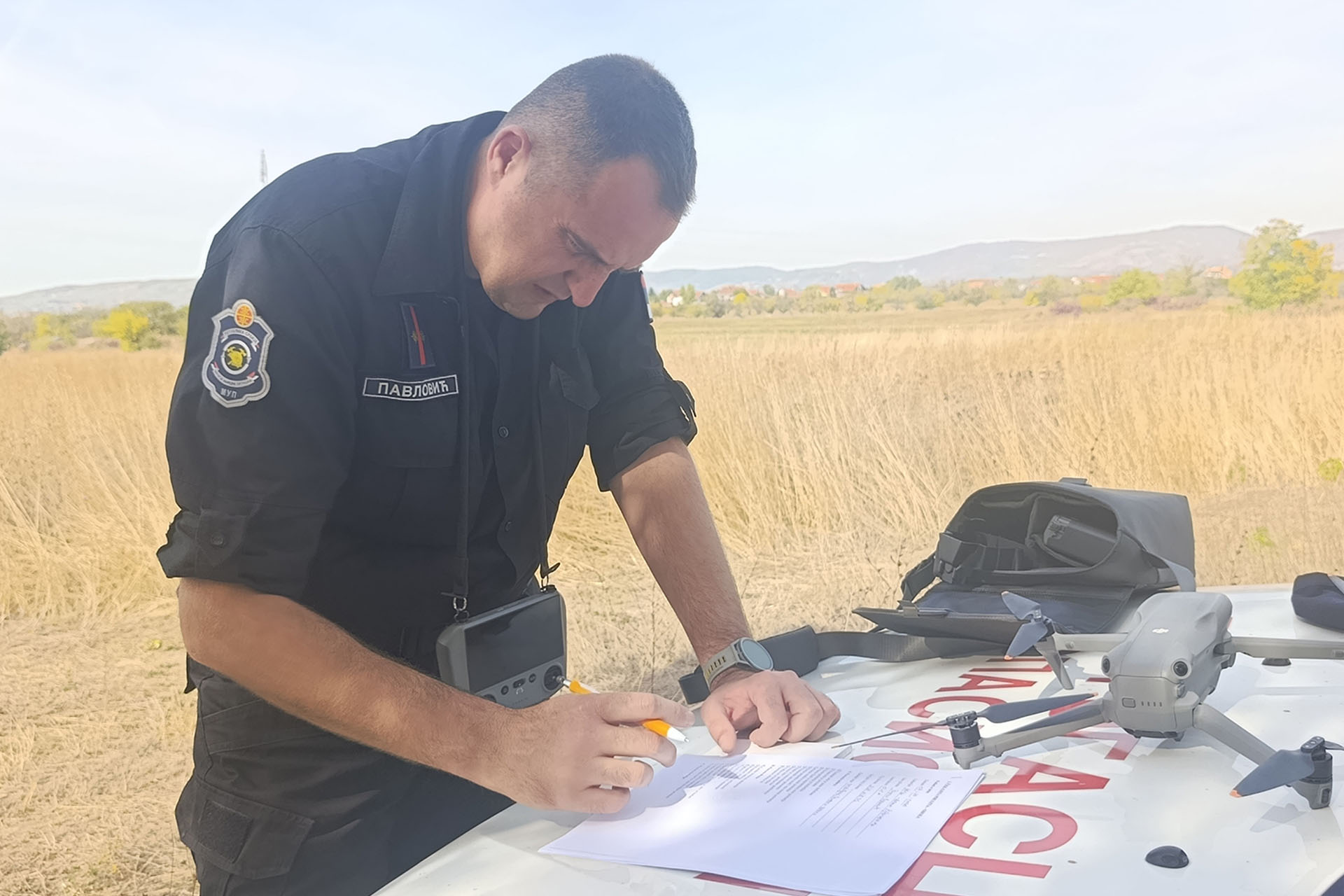
Instructors from the Russian-Serbian Humanitarian Center (RSHC) conducted a training course of the International Civil Defence Organization (ICDO) entitled “Fundamentals of Drone Operation for Wildfire Monitoring.” The defining feature of the programme was its practical component, conducted directly in the area of active wildfires in the Suva Planina mountain range in Serbia, where participants deployed unmanned aerial systems (UAS) to perform real operational tasks.
The five-day course brought together ten officers from the Sector for Emergency Management of the Ministry of the Interior of the Republic of Serbia. Under the guidance of RSHC instructors, participants developed skills in aerial reconnaissance, wildfire monitoring, and the use of unmanned technologies to provide operational information to firefighting and rescue units.
Practical training took place under real emergency conditions, including smoke, reduced visibility, challenging mountainous terrain, and changing weather conditions. Rather than simply improving their piloting skills, participants used drones as operational tools for reconnaissance, situational assessment, and decision-making support.
During operations in active wildfire areas, participants practised detecting and geolocating fire hotspots, assessing the extent and direction of fire spread, identifying threatened infrastructure and other assets, and surveying access routes for ground firefighting and rescue teams. The aerial data provided a more comprehensive picture of the evolving situation and could support the planning of fire containment and suppression operations.
Particular attention was devoted to the use of drones equipped with thermal imaging cameras. Participants practised thermal monitoring of active wildfires and searching for a missing person in difficult-to-access mountainous terrain. Such technologies are particularly valuable when conventional ground reconnaissance is restricted by terrain, smoke, or increased risks to personnel.
A dedicated training module addressed the safe operation of unmanned aircraft in emergency areas. Participants practised coordination with ground response teams, compliance with aviation regulations, and the integration of drone operations with other aircraft involved in wildfire suppression.
A key distinction of the course was the transition from conventional training scenarios to the practical application of unmanned technologies in a real operational environment. This approach develops not only drone piloting skills but also the ability to collect, analyse, and rapidly communicate critical information required for effective emergency response.
Upon successful completion of the five-day programme, participants were awarded certificates issued by the International Civil Defence Organization.
The course delivered by RSHC instructors demonstrates the potential of practice-oriented training within ICDO educational programmes. The experience gained provides a valuable foundation for the further integration of unmanned aerial systems into national firefighting and rescue services, the advancement of wildfire monitoring capabilities, and more effective emergency response.